
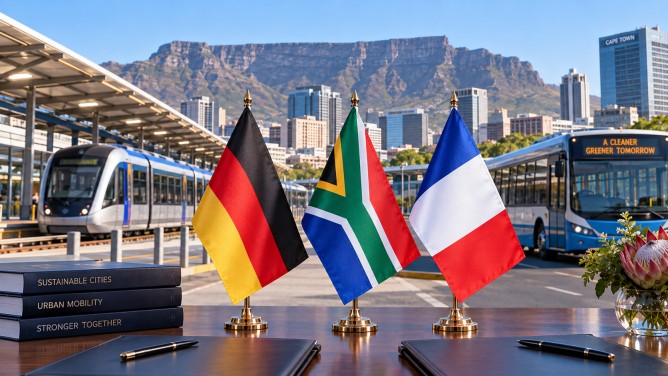
Germany and France have pledged a combined €300 million, equivalent to roughly R5.6 billion, in concessional financing aimed at enhancing essential municipal services across South Africa’s eight metropolitan areas. This financial support is directed towards the Metro Trading Services Reform programme, designed to bolster the financial and operational efficiency of critical services like electricity, water, sanitation, and waste management. The programme’s goal is to ensure that the revenue from these services is reinvested into infrastructure, benefiting over 22 million residents.
Germany is contributing €200 million, while France is allocating €100 million to this initiative. This funding aligns with both countries’ commitments to South Africa’s Just Energy Transition programme. By improving municipal services, the South African government aims to support its energy transition goals and attract more public and private investments, particularly in modernising electricity distribution networks. Despite this substantial commitment, the scale of infrastructure challenges indicates the need for additional financing for municipalities.
Beyond this latest investment, Germany has already extended concessional loans to Johannesburg and Cape Town, focusing on electricity grid upgrades and the integration of renewable energy. Similarly, France has backed various infrastructure and climate-resilience projects across multiple South African municipalities. This ongoing support highlights the broader international effort to assist South Africa in addressing its infrastructure needs.
The reform initiative is part of a larger strategy to enhance municipal governance and financial management, ensuring that essential services can generate enough revenue to sustain and expand infrastructure. For the residents, the success of these reforms will be measured by the improvement in reliability of utilities like electricity, water, sanitation, and waste management, along with the development of financially sustainable systems for long-term infrastructure projects.