
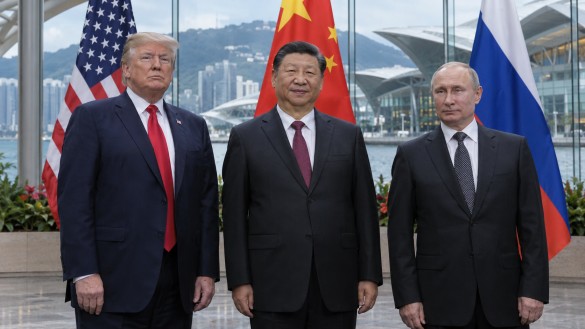
In an unprecedented move, U.S. President Donald Trump, Chinese President Xi Jinping, and Russian President Vladimir Putin are set to meet on the sidelines of the Asia-Pacific Economic Cooperation (APEC) summit in Shenzhen, China, next week. This trilateral meeting, confirmed by the White House, brings together the leaders of the world’s three major nuclear powers to discuss critical global issues.
The discussions are expected to focus primarily on the ongoing conflict in Iran and the potential for a new nuclear arms agreement. With the expiration of the New START treaty between the United States and Russia in February 2026, there is an urgent push from Washington for a new treaty that includes China. Despite possessing significantly fewer nuclear warheads—around 600 compared to over 5,000 each for the U.S. and Russia—China has shown little interest in joining such an agreement.
Beyond the formal agenda, analysts suggest that the meeting’s symbolic significance could outweigh its potential for concrete political breakthroughs. The gathering occurs amid increasing strategic cooperation between Beijing and Moscow, highlighted by China’s economic support for Russia following the Ukraine conflict and Russia’s backing of China’s stance on Taiwan.
Ukraine has expressed concern over the summit, fearing that discussions could occur without its involvement. Ukrainian President Volodymyr Zelenskyy is wary of potential talks regarding the conflict that may sideline Kyiv, though Trump has indicated that Ukraine will not be a primary focus of the trilateral dialogue.
The meeting could potentially enhance China’s global influence and offer Russia a platform to reaffirm its status as a major world power. However, it also presents challenges for China, as balancing its growing partnership with Russia and promoting multilateral cooperation and free trade at the APEC summit could prove complicated.